Mastering Relative Pitch: Your Essential Ear Training Guide
Discover why relative pitch is the most practical ear skill for musicians. Learn a weekly plan to develop your hearing and unlock deeper musical understanding.
In the world of music, our ears are the primary tools for understanding, creating, and performing. While terms like "perfect pitch" often capture attention, it is relative pitch that forms the bedrock of most musical comprehension and fluency. Relative pitch is the ability to recognize and relate notes to each other within a musical context, such as identifying intervals, chords, and melodies. This article will explore why relative pitch is arguably the most useful ear skill for any musician and provide a structured, weekly plan to help you cultivate it.
What is Relative Pitch, and Why Does It Matter Most?
Imagine hearing two notes and being able to tell not just if one is higher or lower, but how much higher or lower it is. That's relative pitch in action. It's the skill that allows you to identify the specific interval between two notes, to recognize a major triad versus a minor triad, or to understand how a melody moves through a key. It's about recognizing relationships and patterns, not isolated sounds.
Contrast this with absolute pitch, often colloquially called "perfect pitch." Absolute pitch is the ability to identify a note by its name (e.g., "that's an A flat") without any reference. While a remarkable ability, it is relatively rare, with research suggesting it is often developed in early childhood or possibly tied to genetic predispositions. For adults, acquiring absolute pitch is an experimental process, and its direct utility in daily musicianship, outside of specific tasks like instrument tuning or transcription, is often less critical than a well-developed sense of relative pitch.
Relative pitch, on the other hand, is a learnable skill for nearly everyone. It empowers you to:
* Play by ear: Translate what you hear into what you play on your instrument. * Improvise and compose: Construct melodies and harmonies that sound cohesive and intentional. * Understand harmony: Grasp how chords function within a key and how they move between each other. * Sight-read more effectively: Hear the music in your head before you play it. * Transpose: Change the key of a song effortlessly.
These are the core skills that enable deep musical engagement, whether you're a performer, composer, or simply a passionate listener. Building strong relative pitch means building a robust internal framework for understanding music.
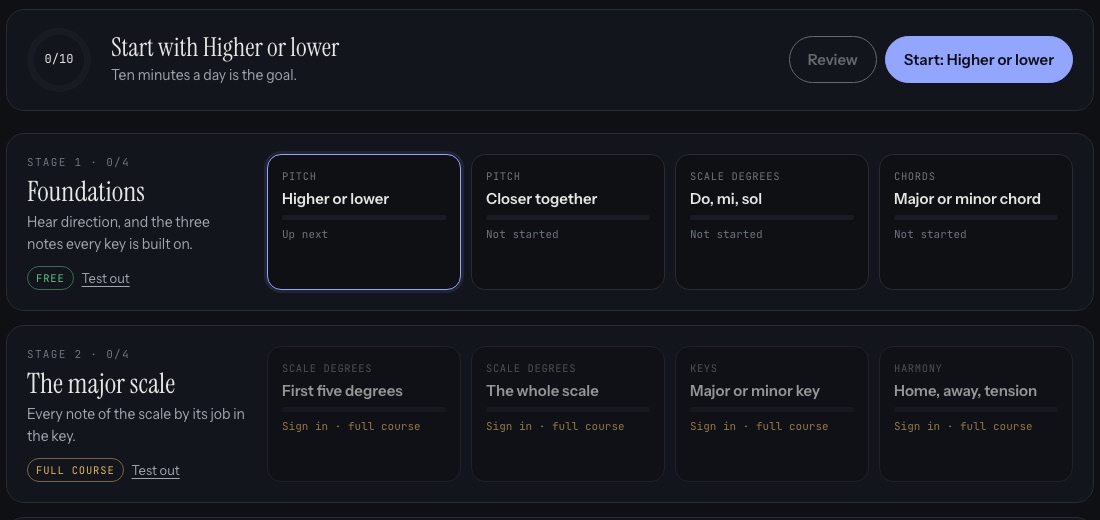
To begin building your foundational ear skills, explore the free first stage of Perfect Pitch Lab, which covers foundational pitch relationships.
Try stage 1 freeThe Foundations: Building Blocks of Relative Pitch
Before diving into complex structures, we start with the simplest relationships. Your journey begins with distinguishing pitches and understanding direction.
* Higher/Lower: Can you reliably identify which of two notes is higher and which is lower? This seems basic, but consistent accuracy here is crucial. * Steps and Skips: Beyond just higher/lower, can you sense if the notes are close together (a step) or far apart (a skip)? * The Tonic (Key Center): Most music revolves around a central note, the tonic, which provides a sense of rest or home. Developing an ear for the tonic helps you orient yourself within a piece of music. Try playing a note repeatedly using a tone generator, then another note. Can you sense if the second note feels stable, tense, or resolved against the first?
Engage actively with these fundamental concepts. Don't just listen; try to hum or sing along, internalizing the sounds in your own voice.
Week by Week: A Structured Path to Strong Relative Pitch
Developing relative pitch is a progressive process. Dedicate 10-15 minutes daily to these exercises. Consistency is more effective than infrequent, long sessions.
Week 1-2: Navigating the Major Scale (Foundations)
Begin by internalizing the most fundamental melodic and harmonic structure in Western music: the major scale. This scale provides a clear framework for understanding note relationships.
Exercises:
* Ascending/Descending: Sing a major scale up and down, focusing on the distinct sound of each scale degree in relation to the tonic. Use solfège (do-re-mi) or numbers (1-2-3) to label the notes. * Note Recognition within the Scale: Have a friend or a simple app play random notes from a major scale. Your task is to identify which scale degree it is (e.g., '3' for 'mi'). Start with notes close to the tonic (1, 2, 3, 5) and gradually expand.
Week 3-4: Mastering Intervals
An interval is the distance between two notes. This is a core component of relative pitch. Focus on common intervals first.
Key Intervals to Learn: Unison, Minor 2nd, Major 2nd, Minor 3rd, Major 3rd, Perfect 4th, Tritone, Perfect 5th, Minor 6th, Major 6th, Minor 7th, Major 7th, Octave.
Exercises:
* Interval Identification: Use an interval ear training tool or have a friend play two notes melodically (one after the other) and harmonically (at the same time). Identify the interval. Focus on the distinct 'color' or 'feeling' of each interval. For instance, a Perfect 5th often sounds strong and open, while a Major 7th sounds dissonant and leading. * Singing Intervals: From a given starting note, sing specific intervals upwards and downwards without reference. Check your accuracy with a tuner or keyboard.
Week 5-6: Recognizing Chords
Once you're comfortable with intervals, move to chords, which are combinations of three or more notes played simultaneously. Start with basic triads.
Key Chords to Learn: Major Triad, Minor Triad, Augmented Triad, Diminished Triad, Major 7th, Minor 7th, Dominant 7th.
Exercises:
* Chord Quality Identification: Use a chord ear training tool to hear different chord qualities played from the same root. Can you reliably distinguish a major triad from a minor triad? Pay attention to the overall feeling – happy/sad, stable/unstable. * Chord Inversion Recognition: Once you can identify the basic quality, try to hear if a chord is in root position, first inversion, or second inversion. This helps in understanding how bass lines move.
Week 7-8: Harmony in a Key
Now, apply your chord knowledge to a musical context. This involves understanding chord functions within a key and recognizing common progressions.
Key Concepts: Tonic (I), Subdominant (IV), Dominant (V), and related minor chords (ii, iii, vi).
Exercises:
* Cadence Identification: Listen for common chord progressions that create a sense of resolution or tension, like a V-I (dominant to tonic) cadence, which sounds conclusive. * Progression Recognition: Practice identifying common chord progressions (e.g., I-IV-V-I, I-vi-IV-V) within a major key. Begin by knowing the key center, then listening for the function of each chord relative to that center.
Week 9-10: Chromatic and Modal Explorations
Expand beyond the diatonic major scale. This involves understanding chromatic notes (notes outside the key) and exploring modes (different flavors of scales derived from the major scale).
Key Concepts: Blues scale, Dorian mode, Mixolydian mode, Lydian mode, notes that create tension or color.
Exercises:
* Modal Listening: Listen to examples of music in different modes. Can you hear the distinct 'feel' of a Dorian melody (often minor but with a raised 6th) versus a Mixolydian melody (major but with a flattened 7th)? * Chromatic Movement: Sing or identify small melodic fragments that include chromatic notes, paying attention to how they resolve or create tension.
Week 11-12: Melodic Dictation and Fine Pitch
Put all your skills together by transcribing melodies. Also, begin to fine-tune your ear to very subtle pitch differences.
Exercises:
* Melodic Dictation: Listen to short, simple melodies and write them down using notation or scale degrees. Start with melodies you already know, then move to new ones. This integrates interval recognition, rhythmic understanding, and a sense of key. * Fine Pitch (Cents): Explore very small deviations from perfect pitch, measured in cents (100 cents = 1 semitone). Practice identifying if a note is slightly sharp or flat. This is crucial for precise intonation in performance.
Consistent Practice: The Key to Progress
No single exercise or technique will magically grant you perfect relative pitch. The journey is one of consistent, active engagement. Make ear training a daily habit, even if for just ten minutes. Listen to music actively, trying to identify intervals, chords, and progressions in songs you love. Apply your ear training to your instrument by trying to play melodies by ear or improvising over chord changes.
Your dedication to these practices will steadily deepen your musical understanding and capabilities.
As you advance in identifying relationships, Perfect Pitch Lab's Stage 3 (Intervals) and Stage 4 (Chords) can refine your ear.
Start the courseYour Journey to Musical Understanding
Cultivating relative pitch is one of the most rewarding endeavors for any musician. It transforms passive listening into active comprehension and gives you the tools to interact with music on a much deeper level. The ability to discern the relationships between notes, chords, and harmonies unlocks a universe of musical expression and understanding.
To begin building your foundational ear skills, you might explore the free first stage of the Perfect Pitch Lab course at https://perfectpitchlab.com/. This initial stage focuses on foundational pitch relationships, a perfect starting point for your journey.
Embrace the process, stay curious, and enjoy the profound enhancement your ears will bring to your musical life. The journey of ear training is a rewarding one, full of discovery and growing mastery.
Mastering relative pitch unlocks a deeper musical understanding, allowing you to hear, play, and create with confidence and insight. The journey of ear training is a rewarding one.
Start stage 1 freeWorks in your browser. No account needed for stage 1.