Charlie Puth's Perfect Pitch: What It Is and How He Hears
Explore Charlie Puth's perfect pitch, the neuroscience behind pitch recognition, and practical listening habits any musician can develop.
You have likely seen the clips: Charlie Puth sitting at a keyboard on a late-night talk show, turning his head at the sound of a studio door, an engine revving, or a phone alert, and naming the exact musical note within a fraction of a second. To an audience, it looks like a parlor trick or a superhuman reflex. He hears an unpitched ambient noise, identifies it as an E-flat or a G-sharp, and strikes the corresponding key without second-guessing himself.
Behind the viral television moments lies an acoustic trait known as absolute pitch—colloquially called perfect pitch. While Puth's rapid-fire demonstrations entertain millions, they also raise practical questions for musicians and curious listeners alike. What is actually happening in the brain during these demonstrations? Is this something an adult can learn, or is it an innate biological trait? And most importantly, what can an everyday listener take away from the way Puth processes the sonic world?
What Charlie Puth Shows in His Demonstrations
When Charlie Puth identifies the pitch of a car horn or a squeaking chair, he is performing two distinct mental operations. The first is pitch isolation: extracting a fundamental frequency from complex, non-musical sound waves that contain mechanical noise, irregular transients, and clashing overtones. The second is categorization: mapping that raw frequency directly to an arbitrary cultural label, such as "B-flat."
Puth has spoken openly about discovering this ability in late childhood, around age twelve, while participating in school music classes and studying jazz. For someone with absolute pitch, musical notes carry distinct, individual identities, much like colors. A visual artist does not need to compare crimson against navy blue to know that crimson is red; they simply recognize the wavelength. Similarly, Puth does not need a tuning fork or a reference piano to know what an F-sharp sounds like. He retrieves the label from long-term memory automatically.
In his production videos, you can see how this skill shapes his workflow. He often composes by singing or playing parts straight into his digital audio workstation without searching for the key or hunting for notes on a keyboard. He knows the destination note before his fingers touch the instrument.
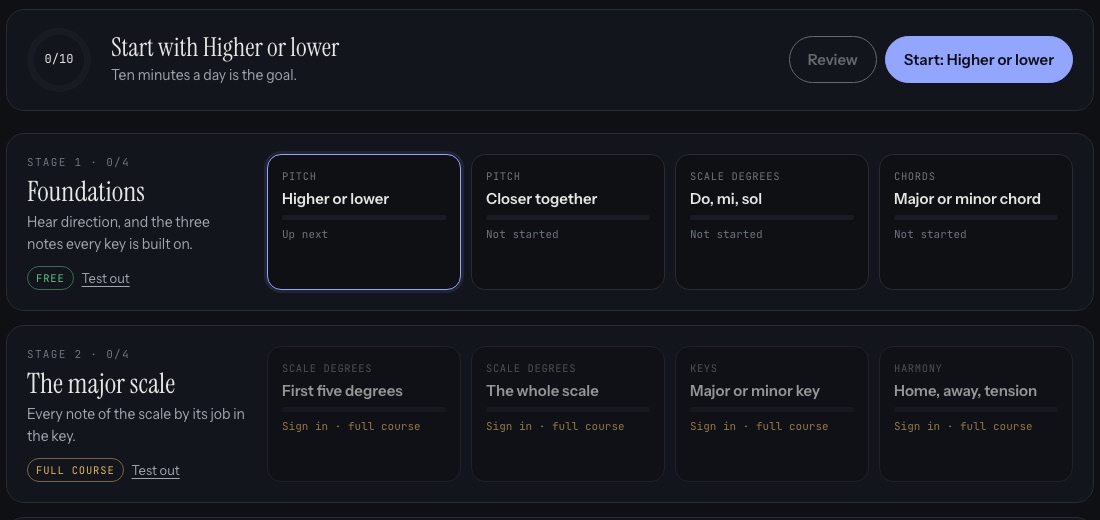
Curious how your pitch perception measures up? Try the free first stage of our pure sine tone course at Perfect Pitch Lab.
Try stage 1 freeAbsolute Pitch vs. Relative Pitch: What the Brain Is Doing
To understand Puth’s listening process, it helps to distinguish between two completely different listening systems: absolute pitch and relative pitch.
* Absolute pitch is the ability to identify or produce a specific musical frequency without any external reference point. If a siren sounds at 440 Hz, an absolute pitch possessor recognizes it immediately as the note A4. * Relative pitch is the ability to identify intervals, harmonies, and melodic movement by comparing notes against one another. If you play an A4 and then play a D5, a musician with trained relative pitch will recognize the interval as a perfect fourth, regardless of whether they knew the starting note was an A.
Scientific literature suggests that absolute pitch is rare. Epidemiological estimates frequently cite an occurrence rate of roughly 1 in 10,000 individuals in general Western populations, though rates are notably higher among musicians who speak tonal languages (such as Mandarin or Vietnamese) and those who began rigorous, formal music training before age seven.
Relative pitch, by contrast, is not a rare neurological phenomenon. It is a universal cognitive skill that nearly any person can develop with practice. In fact, for working musicians, relative pitch is often more valuable than absolute pitch. Absolute pitch tells you a note's name, but relative pitch tells you how that note functions within a chord, a key, or an emotional cadence. If you are curious about your own baseline ability, you can evaluate your spontaneous recognition on our perfect pitch test.
Can You Actually Learn Absolute Pitch as an Adult?
One of the most common questions inspired by Puth's interviews is whether an adult can acquire absolute pitch through dedicated practice. The short answer is: true, effortless absolute pitch appears to rely on a critical period of early brain development, though adults can achieve partial, conscious approximations.
Cognitive research indicates that during early childhood, the human brain treats pitch categories much like phonemes in speech. Infants appear to process music with absolute pitch mechanisms before shifting toward relative pitch, which is more useful for language acquisition (allowing a child to recognize the word "hello" whether spoken by a high-voiced child or a deep-voiced adult). By the time the auditory cortex matures around age eight or nine, the window for effortless, automatic pitch-label encoding largely closes.
Some modern studies have tested whether adult brains can reopen this window using pharmaceutical compounds or intense computer-based repetition. While adult participants in these studies have shown measurable improvements in note identification, the results are typically effortful, slow, and prone to decay once training stops. Adult learners generally rely on conscious deduction rather than the immediate, perceptual "color-like" sensation described by childhood acquirers.
Attempting to force absolute pitch as an adult often yields diminishing returns. However, developing razor-sharp relative pitch—coupled with an internal memory for a few specific reference tones—gives you virtually all the practical musical benefits that Puth exhibits in his studio.
Translating Everyday Sounds into Musical Notes
Puth’s most engaging demonstrations are not about concert halls; they are about everyday life. He listens to telephone dial tones, kitchen blenders, and passing trains, finding the musical pitches hiding inside mechanical friction.
You do not need absolute pitch to develop this habit. Most everyday hums and mechanical noises have a dominant frequency. Household electrical currents in North America oscillate at 60 Hz (close to a low B-flat), while European systems hum at 50 Hz (near a low G). You can explore where these frequencies fall on the standard musical scale using a note frequency chart.
When you start treating the ambient world as a sound source, your relationship with listening changes:
* Listen for the sustained center: When a microwave runs, ignore the initial mechanical clatter and listen for the steady drone. That drone is a fundamental tone. * Match it with your voice: Hum along with the appliance until your voice matches the vibration without "beating" or waving in your ears. * Check your pitch: Pull up a digital tuner or an online tone generator and discover which musical note matches that hum.
This simple habit develops active listening. Instead of letting ambient noise fade into the background, you train your auditory cortex to analyze frequencies consciously.
Strengthen your harmonic vocabulary in Stage 2 and Stage 3, where you learn intervals and chords through pure sine tones.
Start the courseExercises to Train Your Ear Like a Producer
If you want to move toward the speed and clarity Puth brings to songwriting, your goal should not be chasing absolute pitch labels. Instead, focus on building an intuitive, direct link between what you imagine in your head, what you hear in the room, and how you reproduce it on your instrument.
Here are four exercises to build functional, high-level pitch perception:
- Anchor Tone Calibration: Choose one reference pitch—A440 or Middle C are traditional choices. Spend a week listening to this pure tone once every morning. Hum it before you play it, then check your accuracy. Over time, many musicians build a reliable internal physical memory of that single anchor, which they can then use to calculate any other note.
- Interval Singing: Play a random root note. Before touching a second key, choose an interval (such as a minor third or a major sixth) and sing it aloud. Play the target note to confirm. Singing forces your brain to audiate—to hear the pitch internally before producing it.
- Active Bass Line Transcription: When listening to recorded music, ignore the vocal melody and focus entirely on the lowest instrument. Transcribe or hum the bass movement. The bass provides the harmonic foundation; mastering it rapidly accelerates your understanding of song structures.
- Sine Tone Isolation: Natural instruments produce rich harmonics that can distract the ear from the fundamental pitch. Practicing ear training with pure sine waves strips away instrumental timbre, forcing your brain to focus exclusively on pitch distance and frequency resolution.
To build this foundation from the ground up, you can try the free first stage of the ear training course at https://perfectpitchlab.com/, which trains your auditory system to hear microtonal pitch differences using pure sine tones.
Charlie Puth’s absolute pitch is an enviable party trick and a genuine asset in his creative process. But his real musical power comes from how he combines that acoustic trait with thousands of hours of chord theory, rhythmic timing, and active listening. You may not need to name the key of a leaf blower to write a compelling song, but learning to listen to the world with the same curiosity will transform your musicianship.
You do not need absolute pitch to become an exceptional musician. Train your ears systematically from basic frequency discrimination to complex harmony at Perfect Pitch Lab.
Start stage 1 freeWorks in your browser. No account needed for stage 1.