Signs You Have Perfect Pitch: At-Home Checks and Fair Tests
Curious about perfect pitch? Discover simple at-home checks, understand common misconceptions, and learn how to fairly test your absolute pitch abilities.
The concept of perfect pitch, or absolute pitch, captivates musicians and enthusiasts alike. It’s the intriguing ability to name a musical note just by hearing it, without any reference point. You might have wondered if you possess this rare skill, perhaps after identifying a familiar tune or noticing a distinct pitch in an everyday sound. But what truly constitutes perfect pitch, and how can you honestly assess if you have it? Let’s explore the signs, separate fact from common misconceptions, and look at how you might fairly test your own hearing.
What is Perfect Pitch, Really?
Before we dive into testing, it’s helpful to clarify what we mean by perfect pitch. Officially known as absolute pitch, it is the ability to identify or reproduce any given musical note without the aid of a reference tone. If someone plays a random C# on a piano, a person with absolute pitch might instantly say, 'That’s a C#.' This differs fundamentally from relative pitch, which is the ability to identify notes by their relationship to a known reference pitch. Most musical training focuses on developing relative pitch, as it is the foundation for understanding melody, harmony, and transposition.
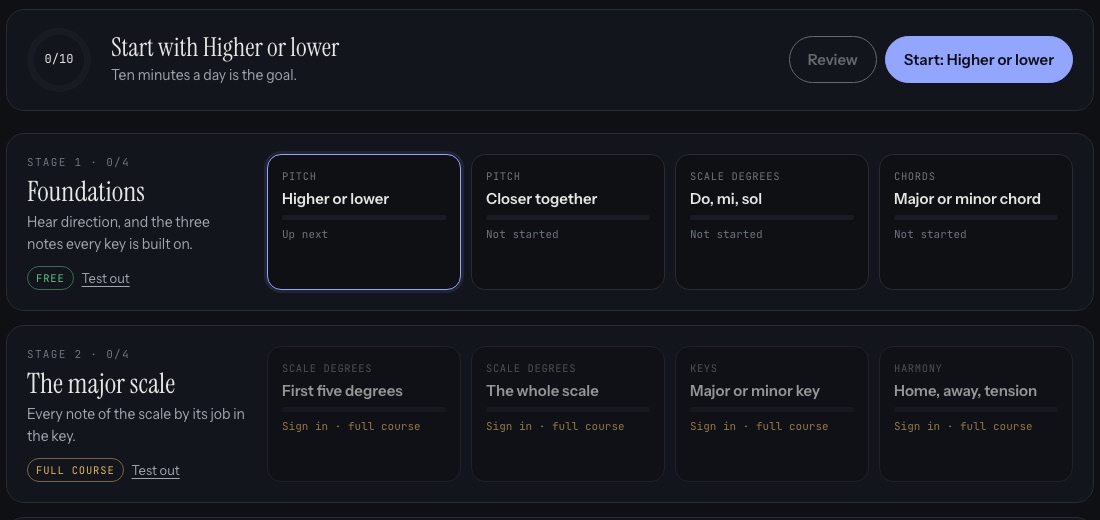
If these checks intrigue you, begin your ear training journey with our free Foundations stage at Perfect Pitch Lab today.
Try stage 1 freeCommon Experiences That Aren't Quite Perfect Pitch
Many people experience sensations that feel like perfect pitch but are, in fact, strong manifestations of other musical skills. It's important to distinguish these, as they are often sources of misunderstanding.
* Strong Relative Pitch: Perhaps you can easily identify intervals – a perfect fifth, a major third – between any two notes. Or you can sing a melody perfectly in tune after hearing a starting note. These are hallmarks of excellent relative pitch, an invaluable skill, but they rely on a reference point, even if implicit. * Knowing a Favourite Song’s Key: You might hear your favourite song begin and immediately 'know' it's in G major. This is often due to deep familiarity with the recording, rather than an absolute identification of the note G. You’ve heard it countless times in that specific key and simply recall it. * Pitch Memory: You might hear a tone and remember it accurately for several seconds or even minutes. This excellent short-term pitch memory is a powerful tool, but absolute pitch involves consistently naming notes over long periods, across different contexts, without this recent memory aid. * Highly Developed Musical Training: Years of immersion in music can lead to a very quick and accurate estimation of pitch. You might hear a note and rapidly deduce its name through a combination of relative pitch, instrument familiarity, and educated guessing. While impressive, this deductive process differs from the instantaneous, unanalyzed recognition characteristic of absolute pitch.
Simple At-Home Checks to Spark Your Curiosity
While a definitive diagnosis requires controlled conditions, you can perform a few simple experiments at home to explore your own pitch perception. These are not scientific tests, but they can offer clues.
* The 'Mystery Note' Test: Go to our tone-generator. Close your eyes or turn away from the screen. Ask a friend to play a random single note, or pick one yourself without looking at the frequency. Before you open your eyes or look at the frequency, try to name the note – is it an A? A C? Be specific about the octave (e.g., A4). Repeat this several times with different notes. How many do you get right instantly, without hesitation? * The 'Everyday Sounds' Test: Pay attention to the pitches of common, non-musical sounds around you. Does the dial tone of your phone sound like a specific note? What about the hum of your refrigerator, or a car horn? While these sounds often aren't pure tones, some people with absolute pitch report hearing them with specific note qualities. This is more of an observation than a test, but it can reveal a unique aspect of your auditory experience. * Singing a Note Without Reference: Can you sing an A440 (the A above middle C, often used for tuning) accurately without hearing it first? Try singing it, then check it with an online-tuner or piano. This demonstrates a form of absolute pitch production, rather than perception, but it is a related ability.
The Fair Way to Test for Absolute Pitch
For a truly fair and reliable assessment of absolute pitch, a more structured approach is necessary. Researchers use specific protocols to eliminate variables and reduce the possibility of guessing or using relative pitch strategies.
* Controlled Environment: The test should ideally take place in a quiet setting, free from distractions. There should be no visual cues – such as seeing a piano key pressed – that could aid identification. * Randomized Notes Across Octaves: A range of notes spanning several octaves should be presented randomly. Presenting notes from just one instrument or within a narrow range might allow for 'pitch memory' or relative pitch strategies to kick in. * Immediate Identification: The listener should be asked to identify the note as quickly as possible. Hesitation or a process of elimination suggests the use of relative pitch or other cognitive strategies rather than instantaneous absolute pitch recognition. * Sustained Performance: A true absolute pitch possessor will consistently identify notes with high accuracy across many trials, over time, and even across different timbres (e.g., piano, sine wave, violin).
You can try a structured test yourself using our dedicated perfect-pitch-test. This tool is designed to present random notes and record your responses, giving you a clearer picture of your abilities under more controlled conditions.
To deeply understand note frequencies and fine pitch, explore Stage 8: Fine Pitch (Cents, Intonation) in our course.
Start the courseWhy Perfect Pitch Is So Fascinating (And What Research Says)
The exact mechanisms behind absolute pitch are still a subject of ongoing research, but several factors are thought to play a role. It appears to develop very early in life, often linked to intensive musical training before the age of six or seven. There is also evidence suggesting a genetic predisposition. What's clear is that absolute pitch is rare, estimated to occur in less than one in 10,000 people, even among musicians.
Crucially, while fascinating, absolute pitch is not a prerequisite for musical success or enjoyment. Most acclaimed musicians rely heavily on highly developed relative pitch, which is an extremely powerful and versatile skill. Learning absolute pitch as an adult is generally considered experimental and challenging, with most ear training courses, including ours, focusing on building robust relative pitch abilities.
Whether these at-home checks spark a deeper curiosity about your auditory world or simply highlight the impressive range of your relative pitch, the journey of ear training is profoundly rewarding. If you're ready to explore the fundamentals of pitch and sound, you can begin our course's free first stage, Foundations, at https://perfectpitchlab.com/.
Ultimately, whether you find signs of absolute pitch or not, the process of deeply listening to and understanding musical sounds enriches your entire auditory experience. Developing your relative pitch unlocks a world of musical understanding, allowing you to navigate melodies, harmonies, and keys with confidence and insight.
Whether you find absolute pitch or not, developing strong relative pitch is a rewarding musical journey. Start your exploration with Perfect Pitch Lab.
Start stage 1 freeWorks in your browser. No account needed for stage 1.